Developing 4-way coordination and speed at the drumset: triplet/swing exercises.
Episode 2. Triplet subdivision exercises i) just bass drum and snare drum ii) BD & SD against a swing ostinato

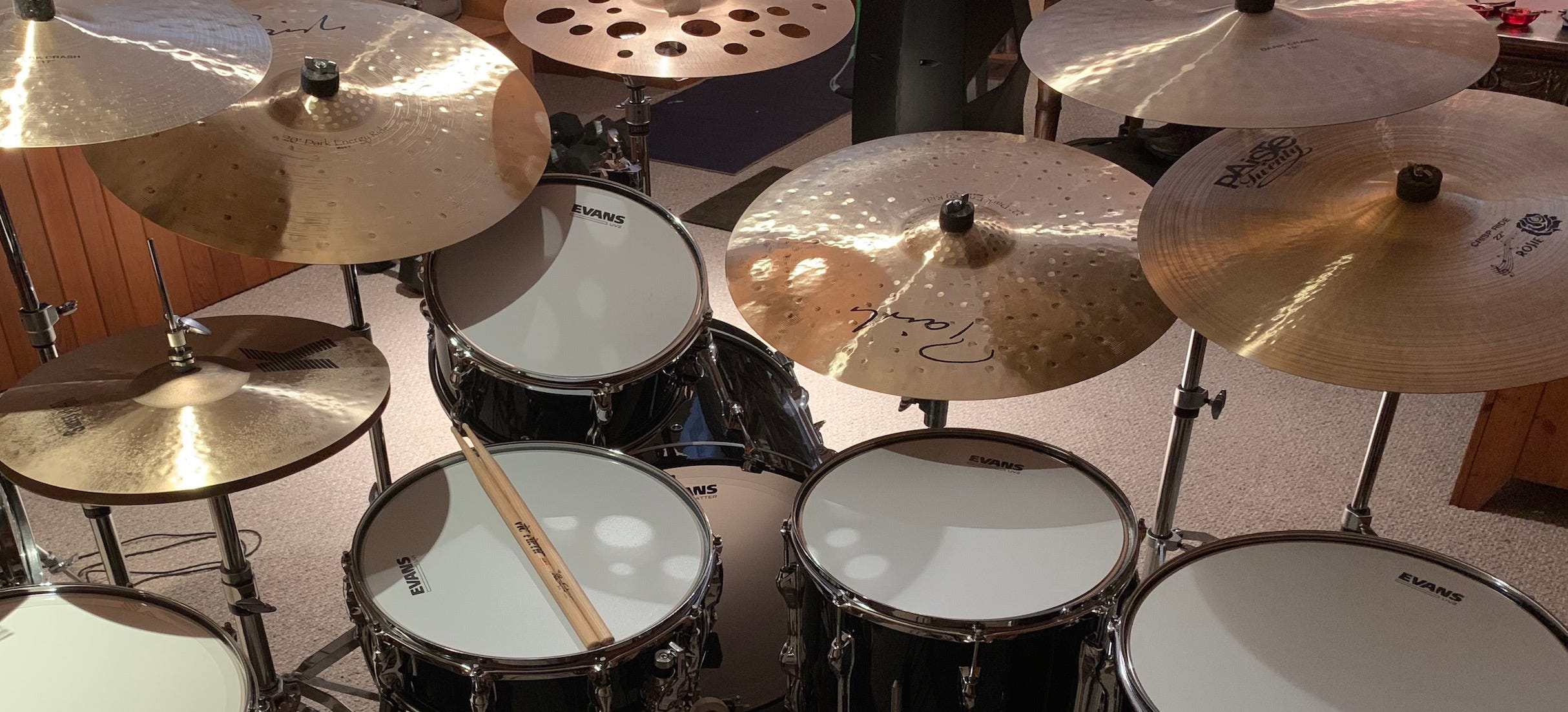
Developing right foot & left hand coordination in a swing context.
Applying motor control rehabilitation principles to these exercises:
start simple, isolate body parts: 2-way coordination at first
cover a spectrum of relevant drumming vocabulary
as skill develops, increase speed only when very slow tempo work is precise
progress to 4-way coordination
Initially, think of each of the following exercises as tests of your drumset coordination…
Each of these exercises represents a specific playing skill. If you can play any one of these exercises really well at 30, 60, 90 and 120 bpm – don’t bother to work on that exercise. If you can play an exercise very cleanly at each of these tempos then you already have that skill; move on to other things you need to work on!
These are technical exercises, not at all musical or artistic; the purpose of these exercises is to develop the technique necessary to be able to start to develop your musical playing abilities, to be able to build your drumming vocabulary. When these technical exercises have been mastered, move on to other practice efforts that develop your artistic capability. For example, John Riley’s ‘The Art of Bop Drumming’ books are a great resource.
The objective is to develop the technical skill necessary to accurately play whatever musical ideas you can think of. If your musical mind can hear a groove, a fill or a comping phrase, you want to have the technical game to execute that musical idea.
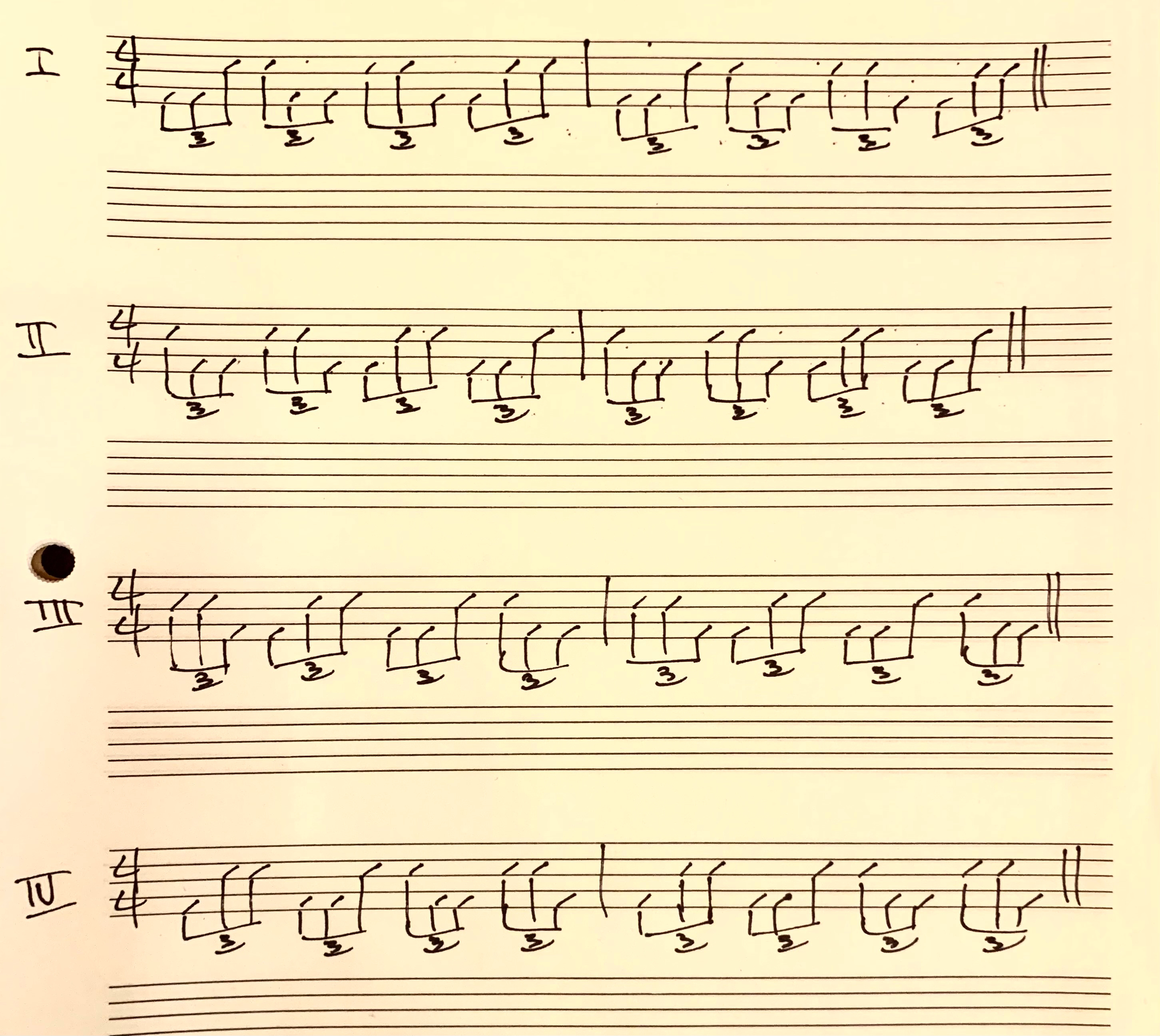
Exercise 1.1
Playing triplets in double stroke pairs between bass drum and snare drum. Begin as slowly as possible; try to start at 30 bpm. If that’s too difficult, start at the slowest tempo you can perform. Initially, play each version (I - IV) as an individual exercise. Work toward being able to play 4 or 8 bar phrases of each version, then string versions I-IV together & play them consecutively. As a set, these versions place the triplet pair at each possible location in the bar relative to each beat of the bar.
As your skill develops, play the exercise at progressively slower tempos until you can play the exercise at 30 bpm. Stay at 30 bpm until you can play the exercise at that tempo comfortably and accurately. Only then should you begin working at faster tempos. Increase tempo gradually, perhaps in 5 bpm increments.
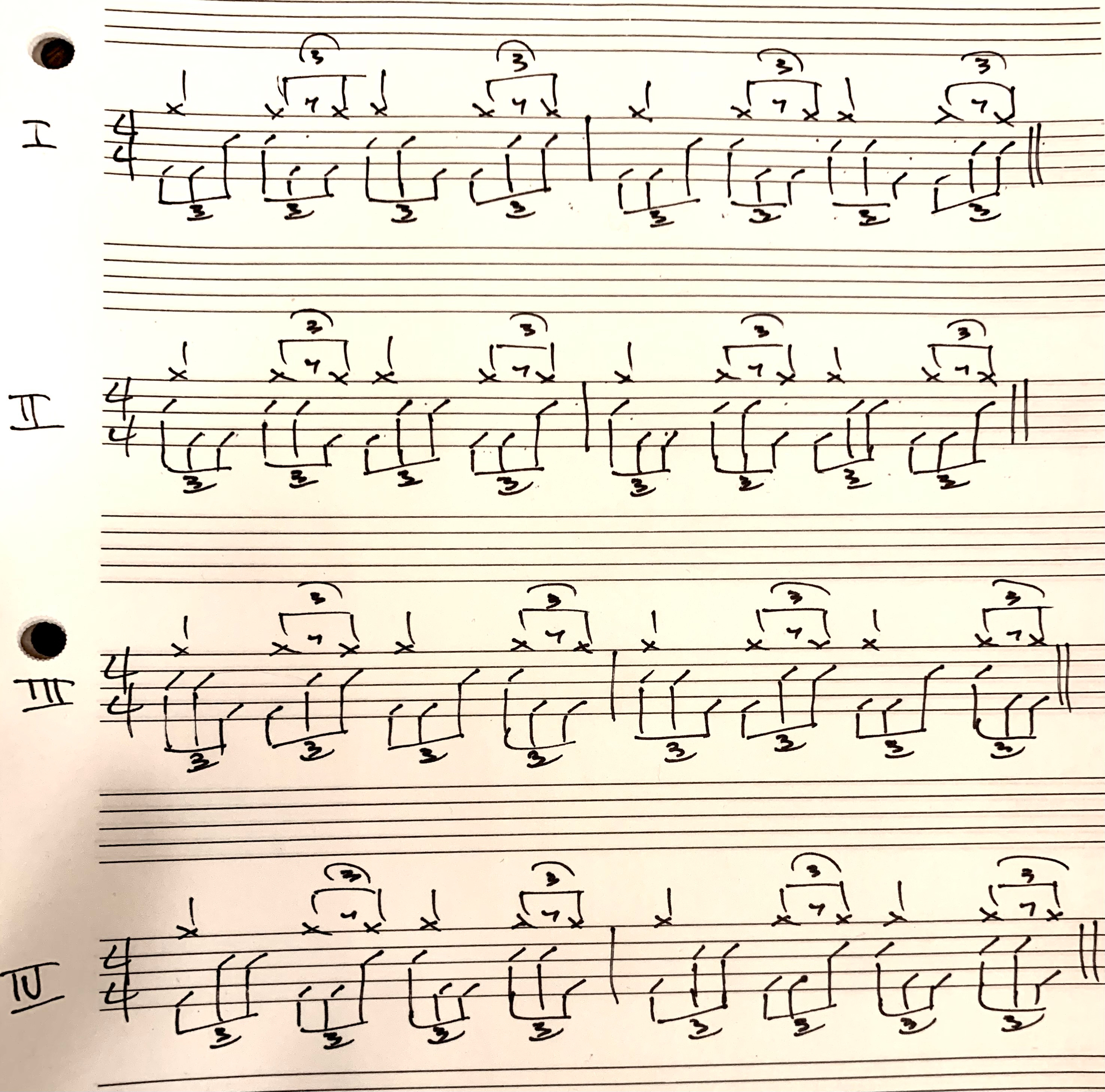
Exercise 1.2
Exercise 1.2 is exercise 1.1 played against a standard issue swing groove. The notation below includes the ride cymbal part but I left the hi hat out to avoid clutter (my copying skills aren’t what they used to be). Play the HH on 2 & 4.
Playing triplets in double stroke pairs between bass drum and snare drum against a swing groove. Begin as slowly as possible; try to start at 30 bpm. If that’s too difficult, start at the slowest tempo you can perform. Initially, play each version (I - IV) as an individual exercise. Work toward being able to play 4 or 8 bar phrases of each version, then string versions I-IV together & play them consecutively. As a set, these versions place the triplet pair at each possible location in the bar relative to each beat of the bar.
As your skill develops, play the exercise at progressively slower tempos until you can play the exercise at 30 bpm. Stay at 30 bpm until you can play the exercise at that tempo comfortably and accurately. Only then should you begin working at faster tempos. Increase tempo gradually, perhaps in 5 bpm increments.
This part is critically important: keep at least 50% of your attention on maintaining a consistent ride cymbal groove. It will be easy to be so focused on the bass & snare drum that we allow the ride cymbal to be drawn toward those two at times rather than the other way round. The ride cymbal sets the groove in swing music - it can’t be anything but perfectly rock solid steady. Keep the ride cymbal pattern locked in and work to play the bass & snare drums to the ride cymbal, not the other way around.
January 28, ‘21 Update:
Here’s a treat! Antonio Sanchez has recently posted short vids of him demonstrating some independence exercises. If you go to Sanchez’s FB page and scroll back to January 28 look for his post entitled ‘Another little independence challenge (swing). (#4)”. This one incorporates the same patterns as Exercise 1.2 I and III above. He plays them better than I do. Go figure:)
Next up:
Episode 3.
Exercise 2: Triplet subdivision exercises in four note combinations
i) just bass drum and snare drum
ii) BD & SD against a swing ostinato